

In this article, we’ll take a brief excursion into the world of Greek myth, and its afterlife, using the rather delightful and recent example of Christopher Nolan’s Odyssey.
Before we do so, a few words on the title of this essay. Firstly, why imagined pasts, and imagined futures? For the simple reason that Greek myth was imagined in the beginning by someone, or some people, likely over several generations, upwards of three thousand years ago, in the lands we now call Greece, the Greek islands, western Turkey, southern Italy and upon the shores of the Black Sea.
And as the world of the Hellenic goddesses, gods, titans, monsters, nymphs, heroines and heroes were first imagined by the Greeks, so too were they reimagined, first by the Romans (who, typically, renamed them too), then by the many generations of wayward Christians that followed them, and now, most recently, by this newest generation of pagans and infidels. No, Mr. Nolan, I’m afraid you weren’t the first!
One of the great advantages that the Greeks and Romans had over their less civilised contemporaries was the written word. While my ancestors were running around Stonehenge in the rain with woad paint on their faces, and the ancient Slavs were wading through the Pripet Marshes (or wherever you believe their homeland to have been), some scribe, or group of scribes, in a Bronze Age court in the Peloponnese or on the shores of Ionia decided to write down the songs and lyric poems of their homeland.
Through many generations, via Arab translators, Byzantine refugees, recalcitrant Christian monks and Renaissance scholars, the texts recording the ancient Greek epics and myths found their way back into European culture. Fast forward to the nineteenth century, and we have a trans-European elite to whom Greek myth and classical literature, and art more generally, were so well-known as to form almost a part of their collective unconscious.
That brings us to the second part of the title; that of ‚past‘ and ‚future‘, and that which is ‚enduring‘. Why this focus? Because Greek myth, if anything, seems to resist being chained to its own time and period. Indeed, it is hard to say when, at all, Greek myth happened. Tying the fall of Troy and Odysseus‘ wanderings on his journey home to Ithaca has always been a fool’s errand, as those criticising Nolan’s historical inaccuracies prove only too well. Greek myth is outside of time, and yet always of its age – only, the age of the observer, not the observed.
For if there is one lesson we can draw from how people in different periods have imagined Greek myth, it is that their tellings of those eternal myths tell us less about the myths than they do about themselves. Odysseus may be the same Odysseus he was three-thousand years ago but, if so, Athena’s certainly changed his clothes many more times than she does in the actual poem itself!
Finally, before we take a more detailed look at those clothes, a last word on the title. ‚Resonance‘ is probably another of those favourite pet-words among this generation of scholars of the classical tradition, but if it is appropriate for anything, it must be so for Greek myth. Without delving Latin etymology to death – that favourite parlour game of scholars for so many centuries, and one fraught with peril – the notion of ‚re-sonare‚ – to ‚sound again‘ – or, perhaps better, ‚to echo‘ – works well as a final framing for the examples we will survey here. For, at the end of the day, what we are dealing with here are ultimately no more than echoes – echoes upon echoes, redounding through the centuries, rebounding off one another, until we arrive at our eminently modern Greek heroines and heroes.
Let’s take a look at some of the story of how we got here, using one example: Homer’s Odyssey. Rather fortuitously, Nolan’s Odyssey has been playing in cinemas for the last few months. Thank you, Mr. Nolan, for timing your multi-billion-dollar epic so considerately of this article! Here, we’ll compare the film’s main characters with their earlier appearances in late-nineteenth and early-twentieth century art.
If the controversy surrounding this adaptation of the Odyssey is anything to go by, we can only wonder what Homer would have made of it. Here[1] you can see what the late nineteenth-century Symbolist painter Pierre Puvis de Chavannes had in mind when he imagined the epic poet. There he is, old man struggling beneath the weight of his terrible inspiration, but don’t worry, Athena hasn’t abandoned him either… There she is with her martial spear and laurel watching over him.
It all looks a bit different, to say the least. And there is little surprise in that. Here, 130 years ago, we are still in the ancient Greece of the Academic imagination of the nineteenth century. Puvis was a Symbolist, but one steeped in the classicism of the Art Academies, whose Arcadias and Parnassuses are perhaps the last distillation of this idealised view of the world of ancient Greek myth. Sunshine on white stone, the blue Aegean, white-armed goddesses, and togate poets.
Wolfgang Petersen’s Troy of 2004 might be considered the most lineal and immediate predecessor of Nolan’s Odyssey. Needless to say, in Troy we are a long way from Puvis de Chavannes. We have, after all, traversed a century of Hollywood sword-and-sandals epics since the days of the Symbolists, and Brad Pitt in the Bronze Age is where we’ve landed. What’s changed since Puvis? A lot, in short. But has everything changed? Probably not. So what’s changed, and what hasn’t, and why? These are the questions scholars of the classical tradition spend a lot of time thinking about.
Superficially, with Nolan we are in very similar territory to Wolfgang Petersen’s Troy. The same eminently modern concern with trying to make everything as historically accurate as possible – while failing in the process. For Puvis and his contemporaries, historical accuracy was a secondary consideration, as it had been ever since the Renaissance, when those Christian monks and Byzantine refugees first reintroduced the western world to the Greek myths. As it was, too, for the directors of the sword-and-sandal epics of the 1950s and 60s.
But a generation has passed since even Petersen’s last adaptation of Homer’s other epic, the Iliad, in 2004. Might we hazard a term like ‚the generation of angst‘, or ‚the age of anxiety‘, for the period that has elapsed since then? Hopefully the underlying sentiment is clear, and it is a sentiment that explains the differing appeal of our two Homeric heroes in the films Troy and Odyssey.
Achilles, the greatest warrior of the Trojan War, is what the Greeks called a demi-god. He suffers from no doubt. Through his mother, the sea nymph, Thetis, he is party to the god’s counsels. He knows that one day Troy will fall, and that victory will be the Greeks’. That is not to say that he cannot feel compassion, as he does for King Priam of Troy in his choice to return to him the body of his slain son Hector. But Achilles has no doubt about even his own death, nor does he fear it. His only fear is whether he will attain to the martial glory that he covets, and whether his honour will be upheld – an honour that he never doubts is his by right of birth. Perhaps that was still enough in the early 2000s, but one wonders what Achilles would be like today. We notably do not see the hero of Troy in Nolan’s Odyssey, though in the original text he appears to Odysseus in Hades to deliver the famous line that: ‘it is better to be the meanest slave on earth, than the king of the underworld.’
Odysseus, unlike Achilles, is a mortal man, even if he is one favoured by the gods – and by his patroness, Athena, in particular. But this is a world in which goddesses and gods have taken sides over the fate of Troy. They hold grudges, have favourites, and can be as arbitrary as children. Odysseus has incurred the wrath of the sea god Poseidon, and as a result cannot sail home to his beloved wife Penelope, and his son Telemachus.
Homer’s Odysseus is cunning, resourceful and quick-witted, and it is for this that Athena and Zeus love him, but also because – in some pre-Christian sense that does not always make sense to our modern sensibilities – he is considered to be a good man. That is, above all, because he observes the ancient laws of hospitality, that hosts must honour guests, and that guests must honour their hosts too – just as the suitors of his wife Penelope so signally fail to do.
While preserving these traits, Matt Damon as Odysseus is also different from Homer’s Odysseus in important respects, and it is in these differences where the epic becomes – as it has been for so many previous ages – a mirror of our own age’s values. That isn’t to say that this Odysseus wouldn’t have been recognisable to the ancients; he certainly would have been, and is essentially true to the text. He is careworn, long-travelled, respectful of the gods, and cunning, as we see in the Cyclops and other episodes. But Nolan gives him the additional overlay of the modern hero of our age of angst too, while also retaining the substratum of the Christian hero of previous eras. He is remorseful for what he has done at Troy, and undergoes his Damascene conversion on the streets of the burning city. Alas, there is little evidence of this in the text, rather the opposite.
Nolan’s Odysseus, too, is not only respectful of his men and his hosts, but of everyone, even the lowliest slaves. It is true that Homer’s Odysseus is said to be decent to his own slaves, and to have treated them well, but he is still very much the ancient hierarch, and a pirate to boot, who sees others‘ slaves and property as fair game for pillage. Also, Nolan’s Odysseus appears to care what women think and feel, which is certainly more than can be said in general of Homer’s hero, who – with the obvious exception of the goddess Athena, and the selective exception of his wife Penelope – evidently doesn’t, just as other Greek heroes don’t more generally. We might recall Theseus abandoning Ariadne after she had helped him defeat the Minotaur, the Argonaut Jason abandoning his lover and the mother of his children Medea, or the Trojan Hector disregarding his wife Andromache’s pleas not to fight Achilles.
Anyway, we’ve been here before. Odysseus has been a star of the visual arts since the Renaissance, but here[2] is a more unusual example by a Czech interwar Surrealist artist, František Janoušek. This is an example of how enduring the legacy of the classics can be. The 1920s and 30s were a period of experimentation in art, in which classicisms of all kinds were generally discarded. But Odysseus is still with us. Janoušek, as many central European artists of the period, was responding to the spectre of a new war. Here we most likely see Odysseus on Ogygia, Calypso’s island, on which she has held him captive, contemplating the unattainable prospect of his homeland of Ithaca.
It’s a different style, and a different period, but in some ways not that far off from Nolan. Nolan’s Odysseus is consistently sombre. There is even little triumph, one feels, in his eventual victory over the suitors – and certainly nothing resembling that in Homer. Nolan even has him speak to the fall of civilisations:
What if the Odysseus you knew lost his way? What if… one night, in a strange city, he saw things that made him think the home he knew couldn’t possibly be there anymore. What if… when he left the belly of the horse, and opened the gates of Troy, he saw ten years of rage pour into that city in one night? We left them a gift, an offering of peace, that they took into their home. We violated all that’s ever sacred between people. It turned a fight into a hunt. To burn the walls of Troy was to burn the world-entire. Including his home. What if he knew, that very night, as he walked through fires, anarchy, and pain – and in a daze of sweaty celebrations that follow – what if he knew exactly what he’d done? One man’s idea, one man’s trick… to break Zeus’s Law forever. We live in a world of palaces, trades, language, blinded with beauty… until we broke it. The breaking of Zeus’s law, spreading like plague. Our age of bronze is collapsing, and maybe he couldn’t bear to see the ruins of what he’d done. Anywhere. Least of all, his home.[3]
Serious stuff. But enough about the man, and on to the more interesting bit: the women. First of all, Penelope, Odysseus’ forlorn wife in Ithaca, besieged by a horde of lowly suitors who wish to marry her, thereby inheriting Odysseus’ wealth and kingdom, and dispossessing his son Telemachus.
Nolan’s Penelope is 100% Homer’s grieving wife-left-behind, and we are given the clear sense that she is intelligent, as she is in Homer, where she is consistently described as being well-matched with Odysseus for her shrewdness and good sense. But she is also a modern woman, strong and independent, and a guide for her son. This, needless to say, is not what she is in Homer, and especially not in relation to her son. Telemachus, on several occasions, like a good Bronze Age Greek, tells her not to meddle in men’s affairs, and go back upstairs to her weaving. Nolan’s Penelope, meanwhile, seems to have a grip not only of court politics, but also of the international geopolitics of the people of the sea. Or some such (I couldn’t be quite sure), in which she schools her naive and overly headstrong son.
Here[4] is one they made earlier. A more traditional portrayal of Penelope by a British Victorian painter, John Stanhope. Like much second-tier Pre-Raphaelite art, a rather saccharine and characterless portrayal of Odysseus’ lamenting wife. One, we cannot help but feel, that would have appealed to Queen Victoria herself, whose own Odysseus, Prince Albert, was sadly never to return. Here we see her with the shroud she is weaving for her father as a ruse to keep her noisome suitors at bay. As with Puvis de Chavannes, we’re still in the space of our idealised Arcadia of ancient Greece – though one transposed into a very Victorian aesthetic of beauty. Penelope and her maidservant have become English roses.
Circe may arguably be the most interesting protagonist of the Odyssey, though we’re spoilt for choice. As those familiar with the tale will know, Circe enchants Odysseus’ men by turning them into pigs (before he prevails upon her to transform them back again). Here’s the bit from the original:
She led them in, sat them on chairs, and blended them a potion of barley, cheese, and golden honey, mixed with Pramnian wine. She added potent drugs to make them totally forget their home. They took and drank the mixture. Then she struck them, using her magic wand, and penned them in the pigsty. They were turned to pigs in body and voice and hair; their minds remained the same.[5]
Nolan’s interpretation of Circe is one of his more creative, and one where we’re firmly back in our own age. She is almost passable as a contemporary Wiccan. At first we are led into seeing her, through Odysseus’ eyes, rather like the judges of the Salem Witch Trials might have seen a seventeenth-century witch. But, after she lifts her spell, her words to Odysseus challenge us to consider whether she isn’t right about him and his warriors’ true nature, after all:
I didn’t turn your men into anything! Look at them. This is what they are. Look at them! Beasts![6]
Here[7] is a very different Circe, this time by another Victorian British Pre-Raphaelite artist, John William Waterhouse. Like all of Waterhouse’s heroines, his Circe resembles more the beautiful enchantress of the text (noting that Circe is akin to Calypso in the story, as a love interest for Odysseus). There is perhaps also closer attention to the mythological background of the goddess – here, Waterhouse is actually not referencing Homer at all, but the later Roman love poet Ovid, in whose Metamorphoses the link is made between Circe and Scylla (the woman transformed into a monster, who harasses Odysseus’ crew after they escape the whirlpool Charybdis, as we see in Nolan). Here, Circe can be seen magically invoking Scylla as she floats above the waves.
Then, of course, we have Helen of Troy. The online commentariat obviously fixated upon Nolan’s Lupita Nyong’o as Helen solely because of her race – alongside the transgender actress Elliot Page, who played the Greek soldier Sinon, whom Odysseus leaves behind to ensure the Trojans take the horse into their city – as if these were the only two issues of interest to modern audiences. They probably aren’t, save to an angry minority online, but – like many of the amnesias of the social-media age – people are largely unaware or uninterested in whether such debates have been had before.
They have, in this case, as in so many others, and if anyone’s interested in the theory of the supposed African influences on ancient Greek civilisation, they have only to look up the controversy around the 1987 publication of Martin Bernal’s Black Athena, which posited an Egyptian and Near Eastern colonisation of ancient Greece, which Bernal argued explained its cultural development, and which was followed by an eighteenth-century European cover-up of this apparent fact. It’s a fun idea, but scholarly consensus today is that Bernal’s reliance on myth and literature over archaeology to argue his case doesn’t really stand up. Still, plenty of fire and fury, worthy of the fall of Troy Helen inspired the first time round!
For much of the history of Western art, Helen was an opportunity for artists to represent their ideal of female beauty. As a result, she in herself becomes a sort of weathervane of those shifting ideals in European art. That’s a long history, but it’s worth noting that she acquired an especial attraction at the fin-de-siècle. With her tragic association with the fall of Troy, and the stories of Achilles, Hector, Odysseus, and all the rest, Helen could in many ways be seen as an archetype of that favourite staple of Art Nouveau and Symbolism, the femme fatale. Here[8] is the French Symbolist Gustave Moreau’s portrayal of Helen, which exists in several versions. We’ve moved away here from the ideal Helens of neoclassicism, and are – as in so many Symbolist paintings – into the territory of what we might call a more ‘Byzantine’ idiom, for want of a better word. Helen here is more of the tragic oriental beauty, girt in opulent robes and flowers, who spells doom for those who draw near her; it’s no accident that Moreau places Helen on the walls of Troy, where she had more conventionally been shown being abducted by Paris, or alongside Aphrodite. Here, isolated as a tragic emblem and femme fatale, the emphasis is more upon eros and thanatos, love and death, an opposition inherent in her story. Even the setting is funereal. She almost appears to be standing on a tomb.
Returning to Nolan’s Helen, an important difference between his and Homer’s Helen – and one which is probably more significant than her appearance – is her actual involvement in the story. The consistent sense we get in the ancient poem is that Helen is in some way detached from the narrative, and not personally implicated in the story. This is Helen’s eyewitness description from Homer, after she returns from Sparta, of how she met Odysseus when he was first trying to infiltrate Troy, and the nearest we come to any sense of remorse on her part for the city’s downfall:
He told me all the things the Greeks were planning. On his way back, he used his long bronze sword to slaughter many Trojans, and he brought useful intelligence to tell the Greeks. The Trojan women keened in grief, but I was glad – by then I wanted to go home. I wished that Aphrodite had not made me go crazy, when she took me from my country, and made me leave my daughter and the bed I shared with my fine, handsome, clever husband.[9]
It is not so much that she has been forgiven her trespasses by her husband and everyone’s just decided to move on. It’s simply that, in this pre-Christian world of Greek myth, as a semi-divine creature herself – being a daughter of Zeus by the mortal Leda, whom he seduced in the form of a swan – Helen is simply above such worldly concerns of morality. For anyone who has seen and can recall the scene of Helen in Nolan, when Odysseus‘ son Telemachus visits her and her husband Menelaus in Sparta, trying to gather news of his father, the implication – not least from Helen’s scar – seems to be of an uneasy marriage following an infidelity (I’m not even going to mention the desperately dull and macho Menelaus, who seems to have wandered out of the 300 film). But oh how delightfully modern it all is!
On to Calypso next, the nymph who holds Odysseus on her island of Ogygia for seven years, delaying his return to Ithaca. Again, a lot of sneering from the critics about how they seemed more on a beach resort than stranded upon a desert island. Excellent. But it does seem to have been a charming place, which Calypso kept rather nicely. Here’s what Homer says:
There sat Calypso with her braided curls. Beside the hearth a mighty fire was burning. The scent of citrus and of brittle pine suffused the island. Inside, she was singing and weaving with a shuttle made of gold. Her voice was beautiful. Around the cave a luscious forest flourished: alder, poplar, and scented cypress. It was full of wings. Birds nested there but hunted out at sea: the owls, the hawks, the gulls with gaping beaks. A ripe and luscious vine, hung thick with grapes, was stretched to coil around her cave. Four springs spurted with sparkling water as they laced with crisscross currents intertwined together. The meadow softly bloomed with celery and violets.[10]
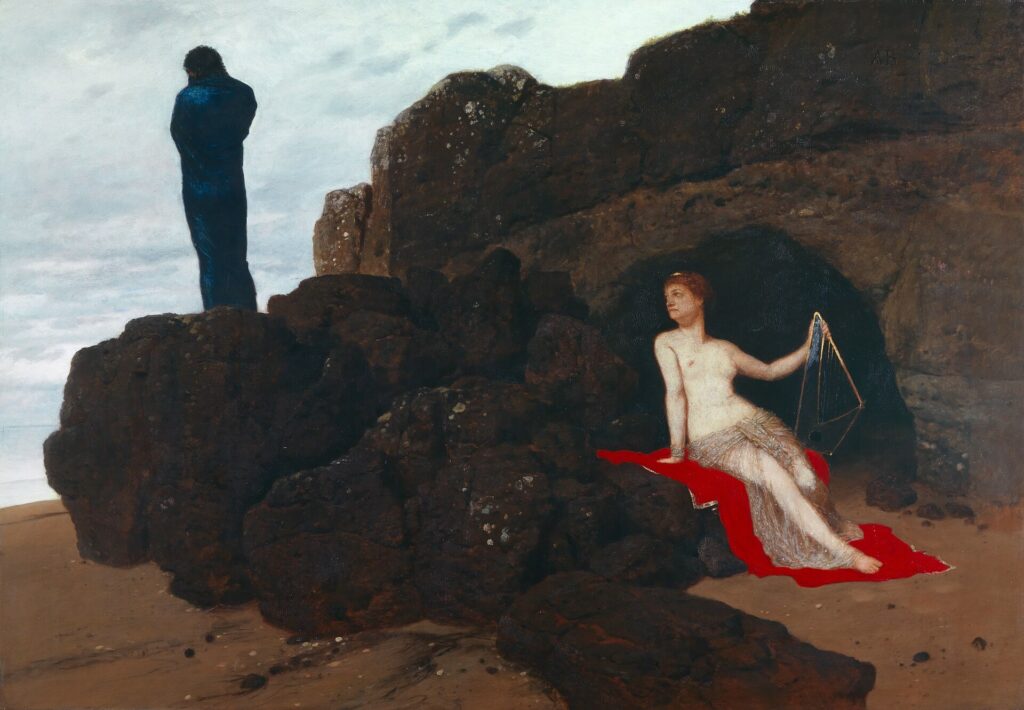
But the point is that Odysseus wanted to go home, and in the history of art this is the emphasis that artists most frequently gave the Calypso episode. Here[11] is a good example by the Swiss Symbolist artist Arnold Böcklin, painted in 1882. The contrast between the bright Calypso and Odysseus’ black silhouette is striking, and illustrative of the isolation and melancholy the hero feels in the poem, while held by Calypso. Our Calypso here, still framed in a neoclassical manner, is already becoming more Symbolist, with her magic lyre and the sea cave behind.
Needless to say, Nolan’s Calypso is a very modern woman. Actually, she even seems to be – dare we say it – a psychologist, and therapist to the druggie Odysseus. Here’s her addressing Odysseus in the film, before she lets him go.
The lotus clouds the mind, saps the will, but doesn’t change who you are. You weren’t ready to go home for whatever reason. You’re a man who needs to control his fate. But you cannot control this. You must give yourself to the storm, give yourself to Poseidon. And take your punishment. Give up the fight, give up control and live. It is a leap of faith you haven’t yet made, Odysseus.[12]
It’s a nice modern interpretation. Never mind that in Homer she shows no inclination whatsoever to let Odysseus go, until Zeus sends Hermes to command her to release him. In Greek myth, if you’re a god you just do what you want, until another more powerful god tells you otherwise. And if you’re Zeus, well, you just do whatever you want, until your wife loses her temper…
The other goddess we see a lot of in the film is of course Athena. This is very much true to Homer’s poem, in which the goddess is Odysseus‘ chief patron and protectress, always taking his side in disputes between the gods, making his case before her father Zeus, and shielding him as much as she can from the wrath of her uncle, the sea god Poseidon. Here she is chiding her dad for forgetting her favourite hero:
I am agonizing about Odysseus and his bad luck. For too long he has suffered, with no friends, sea all around him, sea on every side, out on an island where a goddess lives, daughter of fearful Atlas, who holds up the pillars of the sea, and knows its depths – those pillars keep the heaven and earth apart. His daughter holds that poor unhappy man, and tries beguiling him with gentle words to cease all thoughts of Ithaca; but he longs to see even just the smoke that rises from his own homeland, and he wants to die. You do not even care, Olympian! Remember how he sacrificed to you on the broad plain of Troy beside his ships? So why do you dismiss Odysseus?[13]
At key points in Homer’s poem, Athena appears to aid Odysseus (and also his son Telemachus), either by offering him advice directly, or by steering events in his favour. Nolan’s Odysseus is generally true to Homer’s Athena, as she does much the same thing during the film – though she only takes a single form, rather than the various guises she adopts in the poem, young and old, male and female. The suggestion seems to be made at the end of the film that she has taken the form of a priestess of Troy unjustly slain by the Greeks during their sack of the city.
Similarly to in Homer, we also have the occasional dialogue between Odysseus and his divine patron about his fate, and occasionally about the fate of mortals and piety more generally. For example, we have this exchange between Odysseus and Athena in the film after Odysseus witnesses his men eating the forbidden cattle of the sun god Helios, a deed for which they will all – save him – suffer death at sea:
Odysseus: Why can’t gods speak in ways we understand?
Athena: Who doesn’t understand thunder? Fire? A child’s smile? A good harvest?[14]
Undoubtedly, our hero’s question is framed in a very un-Homeric way – more that of the modern kidult asking why the world isn’t fair, than that of the Bronze Age warrior – but the concern is essentially Homeric in nature. For it hints at the capriciousness of the gods, which is rarely intelligible to mortals – even to the likes of Odysseus, who among ordinary mortals comes closest perhaps to understanding them. That is, with the important exception of the prophets Tiresias, Cassandra and others granted direct insight into the gods‘ counsels for one reason or another (a gift which, incidentally, usually comes with a heavy toll for them).
Nolan’s choice of the actress Zendaya, and the way she plays the role, suggests a level of seriousness that isn’t always there in Homer’s epic. As Emily Wilson points out – the classicist whose translation of the Odyssey inspired Nolan – Athena’s roles in the Odyssey and her relationship with the hero vary widely, where at times she seems more a motherly protector, at times a sisterly guide, and at others is even flirtatious with the hero. That, of course, is typical of an ancient Greek god as they are presented in Greek myths, but less so today. We live in a serious age. So gods, like mortals, need to frown a lot.
Athena was a bit of a darling of Art Nouveau and the Jugendstil too. Here[15] is the Austrian artist Gustav Klimt’s fin-de-siècle Athena. This is a more conventional portrayal of her as martial goddess – a rather wonderful combination of Klimt’s typical Jugendstil gold-leaf work with Athena’s Greek breastplate with its gorgon’s head. Her frontal face and pose have the enigmatic appearance of much of Klimt’s work, but we also have another tribute to ancient Greek art – and, in particular, figural vase painting – in the figure at the top left. Klimt also uses Athena’s full title of ‚Pallas Athene‘, hinting at Athena’s origin story as the slayer of the titan Pallas during the Titanomachy (the Olympians‘ war against the Titans) – a title which also hints at the Trojan War again. Rather confusingly, although the gods took sides in the war, and Athena was with the Greeks against the Trojans, the Trojans had a statue of Pallas Athene called the Palladium, a sacred statue that had become so closely associated with the city that the Trojans believed that if anything should ever happen to it, the city would fall. So perhaps another nod to Homer here.
We should at least briefly touch on the monsters in Nolan, as they’re rather fun and do Homer’s gruesomeness justice, and which of Homer’s monsters is more archetypical than the Cyclops? Firstly, on the one eye… There’s always been some discussion about whether Homer actually says the Cyclops has one eye, and also whether the other Cyclopes also look the same. Later accounts, including that of the poet Hesiod, writing around 700 BC, about a century after the putative Homer is thought to have codified the Odyssey in literary form (assuming he was one person, that is), confirm that the Cyclops has one eye, and the classicist’s argument is generally that Homer also uses the single form for eye when he refers to Odysseus putting it out, rather than the plural (or ‘dual’, a special form in ancient Greek).
Like a lot of monsters in Greek myth, the Cyclops is weirdly monstrous and human at the same time. For a start, despite being a giant, having one eye, and eating people, he has a name: Polyphemus. Like other monsters in Greek myth, Polyphemus has divine ascendants – in his case, being a son of the sea god Poseidon by the nymph Thoosa. Aside from eating humans, he also herds sheep, of whom he seems particularly fond. And in the text, sadly omitted by Nolan as not sufficiently Hollywood-proof, he has a bit of a contest of wits with Odysseus, who at length manages to induce the Cyclops, through flattery, to drink too much of his wine, lulling him to sleep so that he can blind him. Odysseus then pulls a joke at his expense by telling him that his name is ‚Noman‘, such that when the Cyclops‘ brethren ask him if he needs any help, the Cyclops tells them that ‚no man is hurting him‘ and they, consequently, fail to come to his aid.
He of course manages to invoke his father Poseidon’s curse upon Odysseus before he leaves, and this is the bit Nolan does include. Here are the Cyclops’ final words in Homer, as Odysseus and his crew sail away:
Listen, Earth-Shaker, Blue-Haired Lord Poseidon: acknowledge me your son, and be my father. Grant that Odysseus, the city-sacker, will never go back home. Or if it is fated that he will see his family, then let him get there late and with no honor, in pain and lacking ships, and having caused the death of all his men, and let him find more trouble in his own house.[16]
Polyphemus‘ appearance isn’t his only showing in Greek myth. Here[17] the French Symbolist Odilon Redon portrays the other myth generally associated with the Cyclops: his unrequited love for the nymph Galatea. Here we see the one-eyed giant as voyeur of Galatea as she sleeps. Not sure which cyclops is worse, Nolan’s or Redon’s, but they certainly present a rather good contrast between the ways we imagine the monstrous Polyphemus today, and the way an artist steeped in the psychological and intellectual milieu of the fin-de-siècle imagined him. Redon’s painting is a good example of how Greek myth was used to reflect the growing interest in core concepts, such as voyeurism, that would appear in the writings of Freud and others a few years later.
Talking of psychology, we really must have a word on the sirens. They need no introduction, the singing goddesses who lured sailors to their death upon the rocks with their wondrous song – given how proverbial they have become over the centuries. Let’s have Homer’s Odysseus in his own words again:
We traveled fast, and when we were in earshot of the Sirens, they knew our ship was near, and started singing. ‘Odysseus! Come here! You are well-known from many stories! Glory of the Greeks! Now stop your ship and listen to our voices. All those who pass this way hear honeyed song, poured from our mouths. The music brings them joy, and they go on their way with greater knowledge, since we know everything the Greeks and Trojans suffered in Troy, by gods’ will; and we know whatever happens anywhere on earth.’ Their song was so melodious, I longed to listen more.[18]
As the online commentariat have pointed out, Nolan’s approach is creative in that we don’t actually hear the song of the sirens. And how could you represent impossibly beautiful music to the jaded ears of a modern audience? Instead, we get Odysseus‘ telling in retrospect of what they sang to him:
It was all the things you want to be. Then, all the things you wished you never wished for. It was the delicious itch you go to scratch but find it’s under the skin. You can’t reach it. So the delicious itch becomes unbearable. Told you what you most want, is what you most can’t have. And what you most can’t have, is what you already had, and lost. It was the song of all the promises I failed to keep. And it told me I don’t really want to go home.[19]
As Wilson says in the introduction to her translation, in Homer the lure of the sirens‘ song for Odysseus is really in the omniscience it promises him. The chance to know all things that ever happened, including at Troy – which, for a man of guile and cunning like Odysseus, is an impossibly attractive proposition. Nolan modernises this notion. For our melancholic and jaded modern Odysseus, it is rather the forbidden fruit, the impossible-to-attain pleasure that always recedes before us. But it is also, apparently, regret for what we have lost; that which we did not know we had, when we had it. Both of those are quintessentially modern anxieties.
Returning, again, to our core concept of the classical tradition as a mirror for its time, here[20] is the Symbolist Moreau’s interpretation of the sirens. For the most part, in the history of Western art, the sirens were generally shown as three beautiful women. Moreau in large part follows that convention here, although the sirens‘ curling and serpentine feet hint at their underlying monstrous nature. While we do not see the flesh of the rotting corpses around them that Homer describes, there is, nonetheless, something unnerving and ominous about the sirens here, the baleful sunset, and the black rock on which they stand, the graveyard of sailors. The sirens are almost the example par excellence of the motif of the femme fatale.
I couldn’t finish this short essay without at least mentioning Argos, Odysseus‘ old dog. Rather touchingly, when Odysseus at last returns to Ithaca, Argos, who has been placed on a dung heap by the evil suitors besieging Odysseus’ hall, recognises his master after twenty years, even though the hero has been disguised by Athena as an old beggar to avoid his being recognised by the suitors. As Eumaeus, the loyal swineherd, tells the disguised Odysseus in the poem:
He went to hunt in woodland, and he always caught his prey. His nose was marvelous. But now he is in bad condition, with his master gone, long dead. The women fail to care for him. Slaves do not want to do their proper work, when masters are not watching them. Zeus halves our value on the day that makes us slaves.’ With that, the swineherd went inside the palace, to join the noble suitors. Twenty years had passed since Argos saw Odysseus, and now he saw him for the final time – then suddenly, black death took hold of him.[21]
It was a nice touch that Nolan included Argos the dog, despite his limited relevance to the overall epic narrative of his story. And he’s not the only one who’s been touched by the very brief reference to Argos the dog in the Odyssey. Here[22] is the Czech Surrealist Josef Šíma’s interpretation of the moment master and dog recognise each other for a final time. Šíma captures the full pathos of the moment, as the careworn Odysseus and already pallid Argos are isolated in a ruined landscape.
It seems Nolan wasn’t the first to wonder whether for Odysseus, as for so many of us, our pets may be our truest friends. Some things never change…
References
Homer (2017). The Odyssey. Trans. by Emily Wilson. New York: W. W. Norton & Company.
IMDb (2026). The Odyssey (2026) – Quotes. Internet Movie Database. Available at: The Odyssey (2026) – Quotes – IMDb (Accessed: 1 October 2026).
[1] Pierre Puvis de Chavannes, Homer: Epic Poetry (reduction of mural in the Boston Public Library), c. 1895. Oil on canvas, 124.5 × 63.2 cm (Museum of Fine Arts, Boston).
[2] František Janoušek, Odysseus’ Longing, 1941. Oil on canvas, 61 × 50 cm (Muzeum Umění, Olomouc).
[3] IMDb, The Odyssey, “Quotes”.
[4] John Roddam Spencer Stanhope, Penelope, 1864. Oil on canvas, 107 × 81 cm (private collection).
[5] Homer, Odyssey, trans. Wilson, 10.233–41.
[6] IMDb, The Odyssey, “Quotes”.
[7] John William Waterhouse, Circe Invidiosa, 1892. Oil on canvas, 180.7 × 87.4 cm (Art Gallery of South Australia, Adelaide).
[8] Gustave Moreau, Helen on the Walls of Troy, c. 1885. Watercolour, 33 × 24 cm (Musée Gustave Moreau, Paris).
[9] Homer, Odyssey, trans. Wilson, 4.256–64.
[10] Homer, Odyssey, trans. Wilson, 5.58–73.
[11] Arnold Böcklin, Odysseus and Calypso, 1882. Oil on mahogany wood, 103.5 × 149.8 cm (Kunstmuseum Basel).
[12] IMDb, The Odyssey, “Quotes”.
[13] Homer, Odyssey, trans. Wilson, 1.48–62.
[14] IMDb, The Odyssey, “Quotes”.
[15] Gustav Klimt, Pallas Athene, 1898. Oil on canvas, 75 × 75 cm (Wien Museum, Vienna).
[16] Homer, Odyssey, trans. Wilson, 9.528–35.
[17] Odilon Redon, The Cyclops, c. 1914. Oil on canvas, 65.8 × 52.7 cm (Kröller-Müller Museum, Otterlo).
[18] Homer, Odyssey, trans. Wilson, 12.180–92.
[19] IMDb, The Odyssey, “Quotes”.
[20] Gustave Moreau, The Sirens, 1882. Oil on canvas (Harvard Art Museums/Fogg Museum, Cambridge, MA).
[21] Homer, Odyssey, trans. Wilson, 17.315–27.
[22] Josef Šíma, The Return of Odysseus, 1943. Tempera and oil on canvas, 128 × 162 cm (National Gallery Prague).


